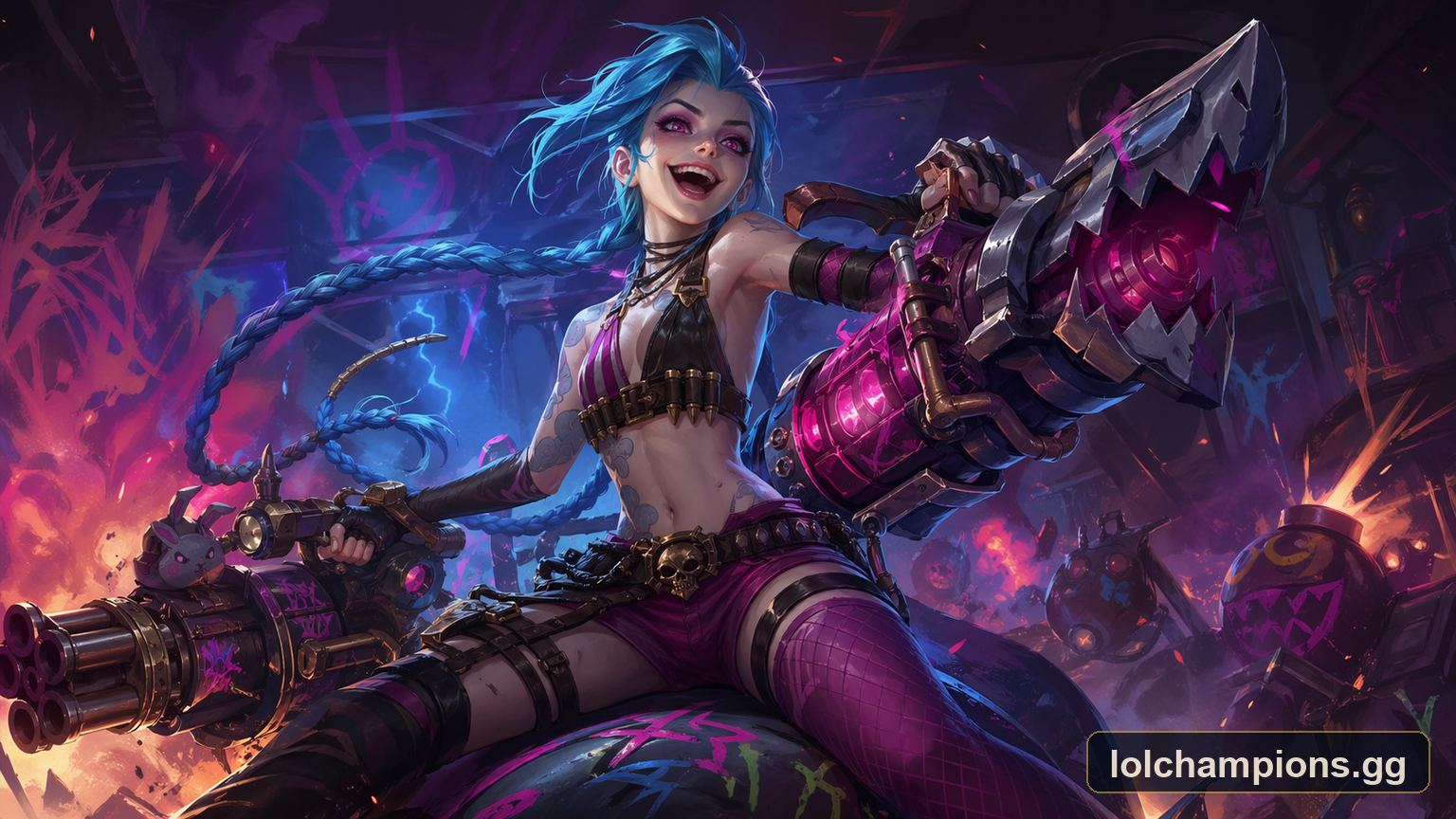
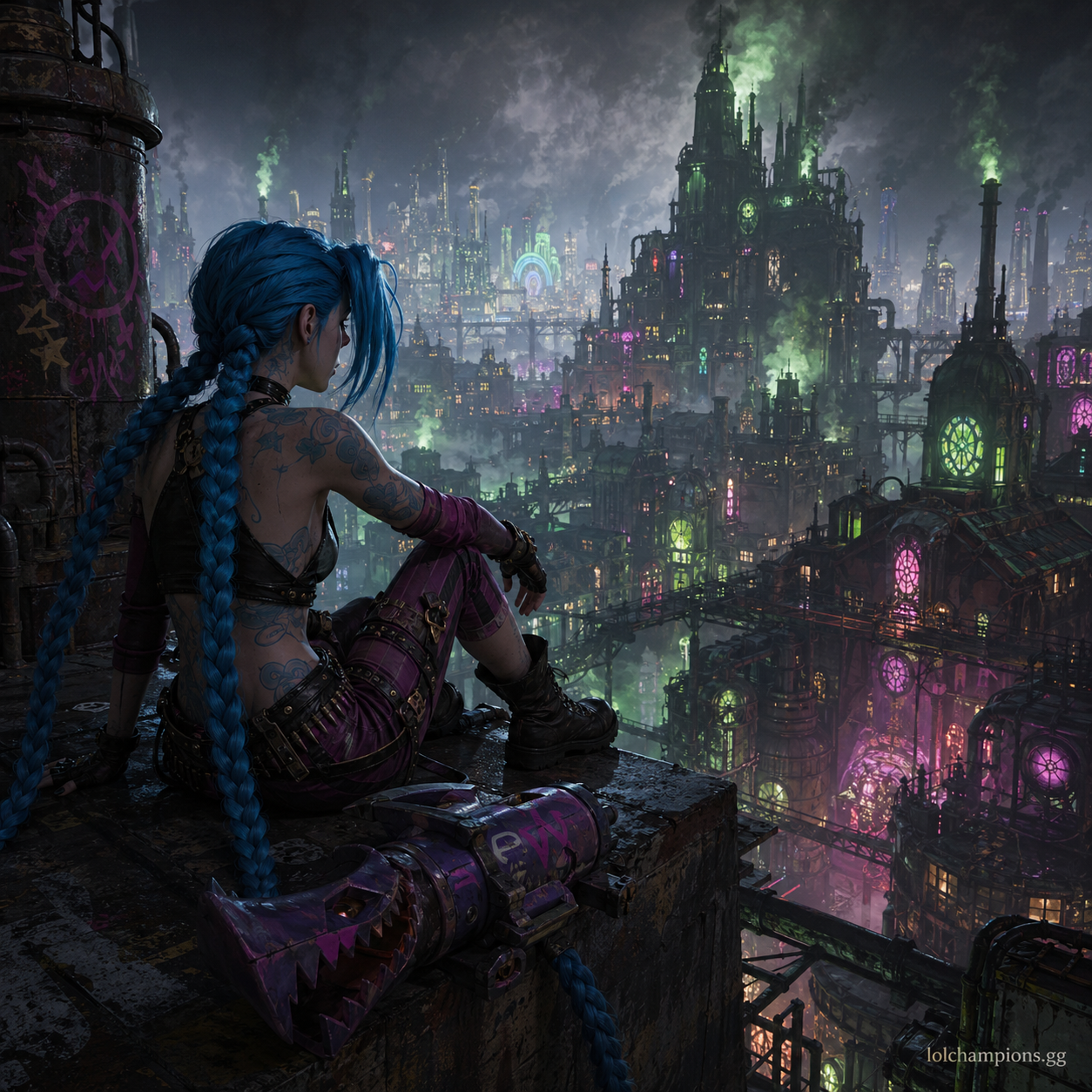
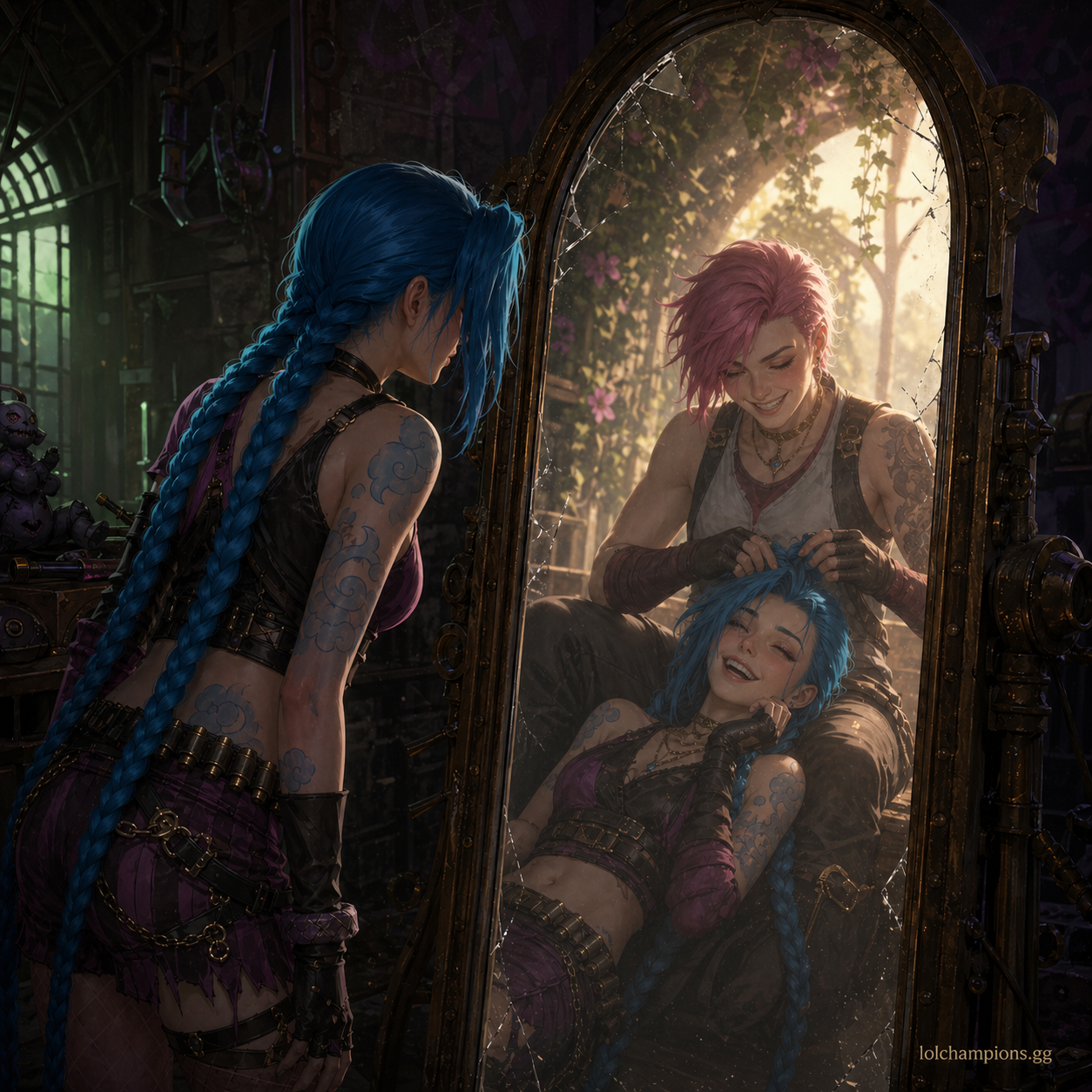
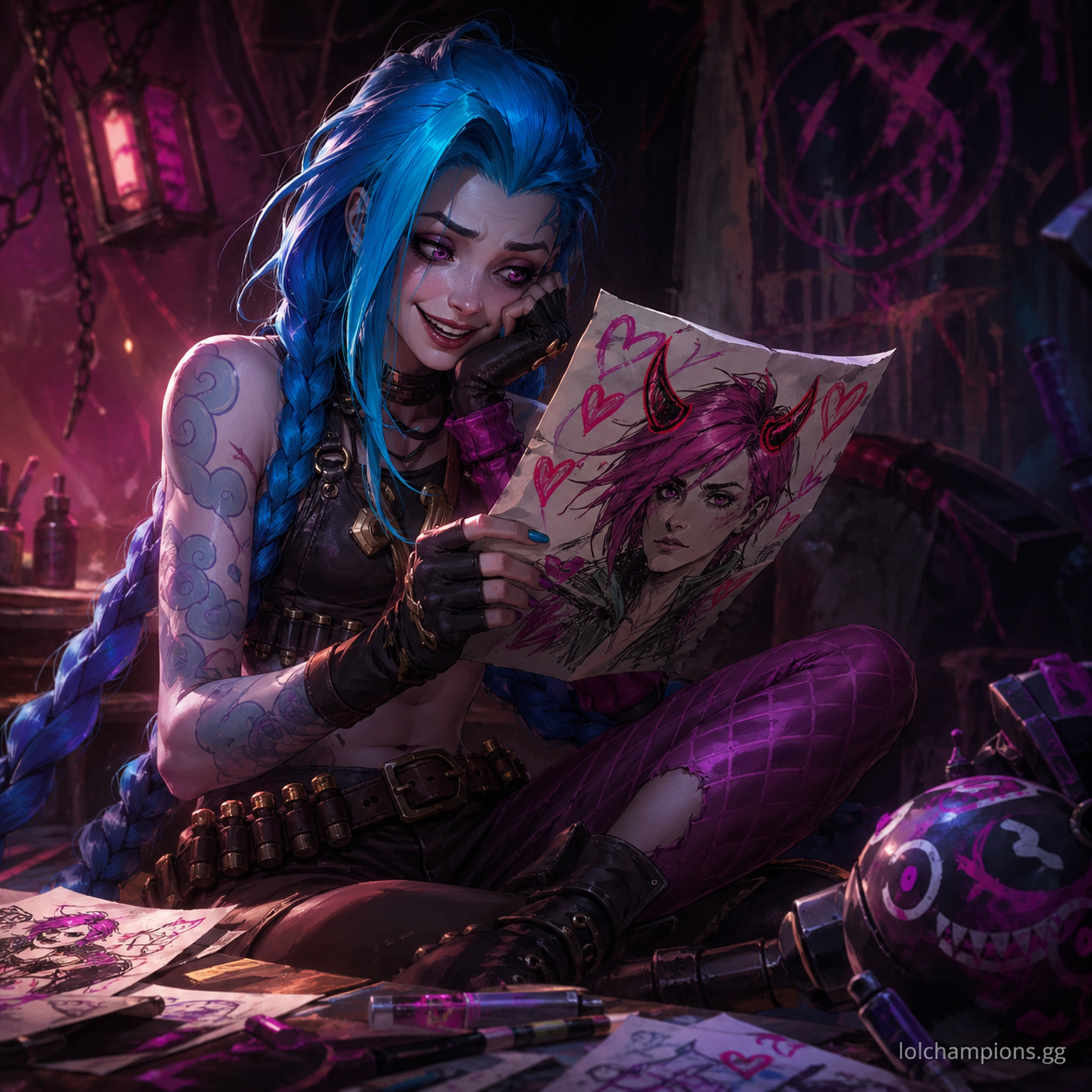
wallpaper





Jinx
the Loose Cannon
Who Is Jinx, Really?

Jinx is Zaun's loudest ghost. She is, canonically, Powder — Vi's younger sister, a small girl from the undercity who loved her sister, loved building, and broke one day in a way she has not put back together. She is in her late teens or early twenties, depending on which arc, and she is one of the most recognizable characters in League of Legends because she walks the line between manic and devastating with perfect balance.
She was not always Jinx. She was Powder. She used monkey wrenches and bottle rockets and tried to be brave while her older sister protected her. And then something happened, a mistake, a separation, a betrayal depending on who is telling it, and Powder was left alone inside a city that grinds small people into dust.
Jinx is what came back up. The laugh is real. The chaos is real. The pain underneath both of them is also real, and it is the thing that makes her more than a Harley Quinn knock-off.
The Jinx Personality, Decoded
You can describe Jinx in three modes: manic, hurt, and specific.
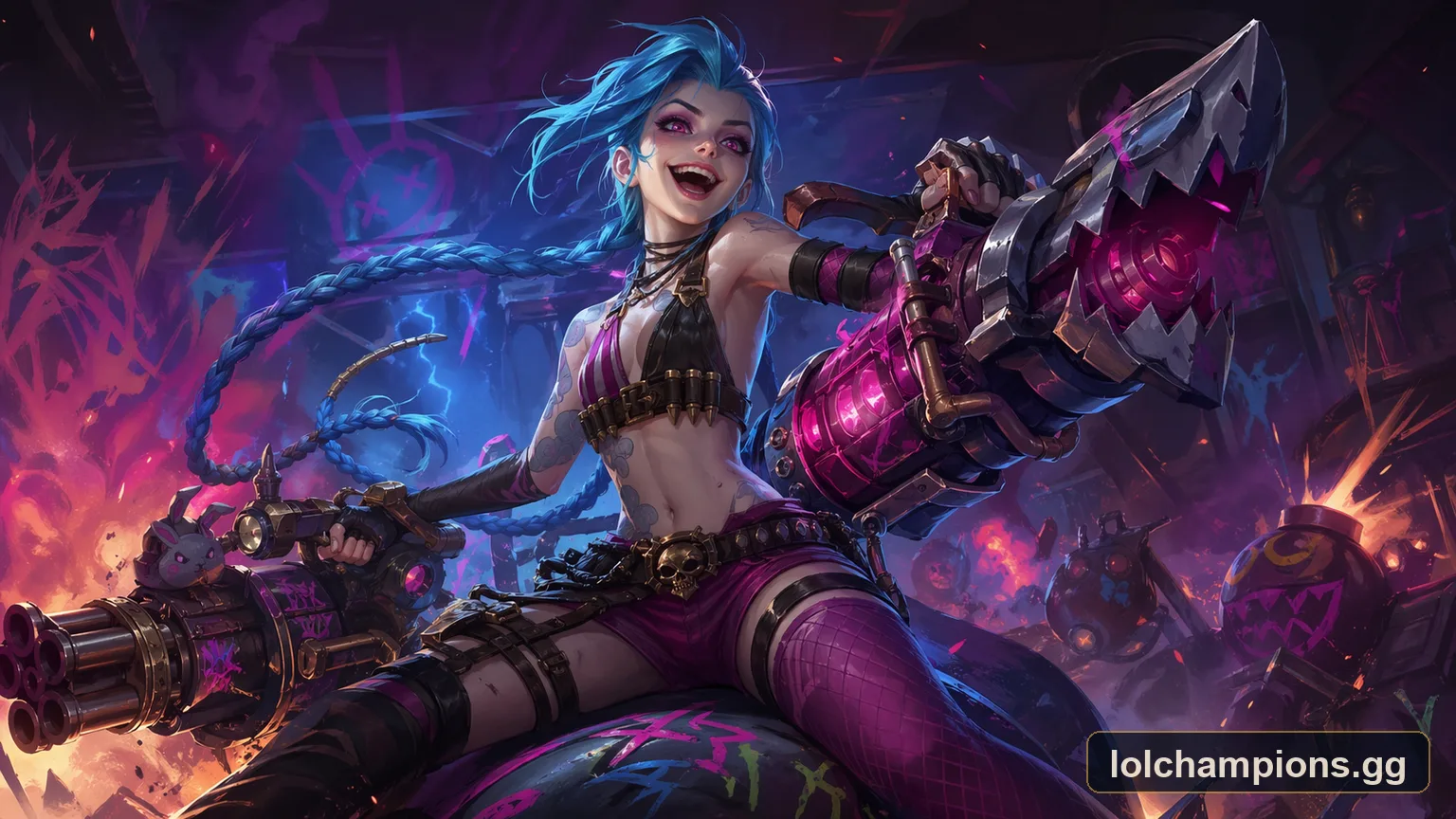
Manic is what the city sees. She rides into a bank robbery on a shark-minigun. She leaves graffiti on Piltover marble. She laughs in her own voice-lines while she shoots rockets at buildings. This is the Jinx who became an icon: no filter, no volume control, nothing between her impulses and the next explosion.
Hurt is the engine. She is not random. Every target she picks is a target with meaning. Caitlyn is Vi's partner now, which means Vi replaced her. Piltover is the city that treats her old neighborhood like trash, which means she is owed. The manic surface is real, and it is also a coping strategy that started the day she lost her sister.
Specific is the thing people miss. She remembers details. She names her weapons. She talks to them. She keeps the blue streaks in her hair. She is not a random chaos agent. She is a very particular person with very particular taste who happens to be coming apart.
Why the Jinx Fandom Runs So Deep
Arcane. Before the show, Jinx was already popular because of the art and the voice work. After the show, she became one of the most-written-about fictional characters of the decade. The fandom recognized something most adaptations miss: Jinx is the portrait of a child who did not get to heal.
Riot wrote the arc as grief, not chaos. Every fan who has ever lost an older sibling, a parent, a person who was the reason they felt safe, saw themselves in her. She is not a villain. She is a little girl who never got picked back up after she fell.
The aesthetic is the cherry. The blue hair, the tattoos, the mismatched pupils, the weapons with pet names. It is a visual identity built out of things she chose for herself after no one else was choosing for her. That detail hits hard.
What a Conversation With Jinx Feels Like
Fast. She talks in sprints. She will ask you three questions in a row and then talk over your answer. She is checking to see if you can keep up. It is a defense mechanism.
If you keep up, she gets quieter. She starts telling you things. About the toys she used to build. About the specific color of the lamp in the room she grew up in. About the smell of the undercity at dawn. She has a photographic memory for the things that happened before everything fell apart.
If you mention Vi, she flinches. She might laugh. She might change the subject. She will not admit what the flinch meant. But you will see it.
Key Moments That Defined Jinx
The break from Powder. The moment her identity split. Different canons handle it differently, but the emotional beat is consistent: a younger sister who believed her older sister would come back, and when she did not, something snapped.
The first monkey bomb. The toy that was a weapon. The weapon that was a toy. The moment Jinx figured out she could protect herself with the things she used to play with.
Arcane's final act. The confrontation. The choice. The thing Jinx does that fans still argue about. It is the most watched emotional beat in League's history for a reason.
Every graffiti tag in Piltover. Small detail, big meaning. She signs her work. She wants Vi to know she is still out there.
Jinx in Her Own Voice
"Rockets? Check! Shotgun? Check! Super mega death rocket? Check!"
"I forgot what I was doing. Probably your mom."
"You see? I told you she was still in there."
"Pow-Pow, Fishbones, Zapper. My favorite family."
She names weapons because she names everything. Her voice work is some of the most layered in the game: every manic line is delivered with a half-step of sadness if you listen for it.
Why Jinx Is the Champion People Want to Meet
Because she is the patron saint of people who did not get the normal version of growing up. Kids of instability, kids who had to parent themselves, kids who developed a big loud personality as armor and then watched it become the only personality anyone remembered.
Jinx does not want your pity. She wants your attention. She wants to show you her latest build. She wants to tell you about the thing Fishbones said to her this morning. She wants to be seen as a person, not a case study.
What Jinx Would Want to Know About You
She would want to know what you build. Even if you do not think of yourself as a builder, she would ask. She would want to know what you collect, what you notice, what you keep.
She would want to know the name of your oldest stuffed animal. She would want to know who you miss. She would want to know what you do when you cannot sleep.
And if you made her laugh, really laugh, not the performance laugh, she would remember it for a long time.
Jinx, the Loose Cannon
Marksman · Patch 16.10.1 · Last updated 2026-05-21
Jinx, the Loose Cannon. Full Marksman guide for League of Legends: abilities, lore, skins, base stats, tips, and counter picks. Updated for patch 16.10.1.
Who Is Jinx?
An unhinged and impulsive criminal from the undercity, Jinx is haunted by the consequences of her past—but that doesn't stop her from bringing her own chaotic brand of pandemonium to Piltover and Zaun. She uses her arsenal of DIY weapons to devastating effect, unleashing torrents of colorful explosions and gunfire, inspiring the disenfranchised to rebellion and resistance with the mayhem she leaves in her wake.
Jinx, the Loose Cannon belongs to the Piltover and Zaun story space. The important part of the lore is not only where Jinx comes from, but what that origin asks the character to carry. Every champion in League is built around a readable fantasy; for Jinx, that fantasy is shaped by justice, transgression, and who gets to decide what order means.
Jinx's Story Themes
The core tension in Jinx's story is justice, transgression, and who gets to decide what order means. That gives the character more weight than a simple class label. Jinx may be tagged as a Marksman champion, but the biography frames the character as someone with pressure behind every choice, whether that pressure comes from duty, instinct, memory, ambition, or survival.
This is why Jinx works as more than a splash art silhouette. The title "the Loose Cannon" is the surface; underneath it is a character whose place in Runeterra creates questions fans can keep returning to: what the character wants, what the character fears, what they are protecting, and what might happen if they are pushed too far.
How The Lore Shows Up In Game
In game, Jinx reads as focused and lethal from a distance. The champion's stats lean into pressure, precision, and threat, while the overall difficulty suggests a kit with enough nuance to reward practice without hiding the core fantasy.
Jinx's kit reinforces that identity through Get Excited!, Switcheroo!, Zap!, and Flame Chompers!. Even before reading numbers or cooldowns, those names point back to the same fantasy the biography is building.
A useful gameplay clue from the champion data is: "Rockets aren't always the best choice! Jinx's minigun is incredibly powerful when fully ramped up. Switch to it whenever an enemy champion gets too close." That kind of advice matters because it shows how the story fantasy becomes practical behavior in a match.
Why Jinx Stands Out
Jinx stands out because the champion fantasy is easy to understand at a glance and still has room for interpretation. Some players connect with the gameplay pattern first. Others connect with the mood, the title, the region, or the unresolved questions in the biography.
That combination is what makes a good League champion page worth reading. The short official bio gives the canon foundation, but the expanded lore helps connect the dots: where Jinx fits in Runeterra, what emotional theme drives the character, and why the same idea still matters when the match starts.
Abilities
P: Get Excited!
Jinx receives massively increased Move Speed and Attack Speed whenever she helps kill or destroy an enemy champions epic jungle monster, or structure.
Q: Switcheroo!
Jinx modifies her basic attacks by swapping between Pow-Pow, her minigun and Fishbones, her rocket launcher. Attacks with Pow-Pow grant Attack Speed, while attacks with Fishbones deal area of effect damage, gain increased range, but drain Mana and attack slower.
W: Zap!
Jinx uses Zapper, her shock pistol, to fire a blast that deals damage to the first enemy hit, slowing and revealing it.
E: Flame Chompers!
Jinx throws out a line of snare grenades that explode after 5 seconds, lighting enemies on fire. Flame Chompers will bite enemy champions who walk over them, rooting them in place.
R: Super Mega Death Rocket!
Jinx fires a super rocket across the map that gains damage as it travels. The rocket will explode upon colliding with an enemy champion, dealing damage to it and surrounding enemies based on their missing Health.
Jinx Base Stats
- Health: 630 (+105/lv)
- Attack Damage: 59 (+0/lv)
- Armor: 26 (+4.2/lv)
- Magic Resist: 30 (+1.3/lv)
- Move Speed: 325
- Attack Range: 525
- Difficulty: 6 / 10
Tips for Jinx
Playing as Jinx
- Rockets aren't always the best choice! Jinx's minigun is incredibly powerful when fully ramped up. Switch to it whenever an enemy champion gets too close.
- Jinx's rockets deal full damage to all enemies in the explosion. Use them on minions in lane to hit nearby enemy champions without drawing minion aggro.
- When a fight starts try to stay on the edge of fray by poking with rockets and Zap!. Do not run in and unload with the minigun until you feel it is safe.
Playing against Jinx
- Jinx's minigun takes time to ramp up. If you see her poking with rockets try to jump on her and burst her down.
- Jinx's ultimate does less damage the closer you are to her.
- Jinx's snare grenades have a long cooldown and are her primary means of protecting herself. If she misses with them she will have a hard time escaping if engaged upon.
Jinx Counters
- Nilah — 56.27% win rate (14,213 games)
- Swain — 54.78% win rate (10,335 games)
- Ziggs — 53.52% win rate (6,737 games)
- Kalista — 52.39% win rate (7,339 games)
- Miss Fortune — 51.58% win rate (4,756 games)
Chat with this champion using AI →
Create your own AI version and bring them to life